
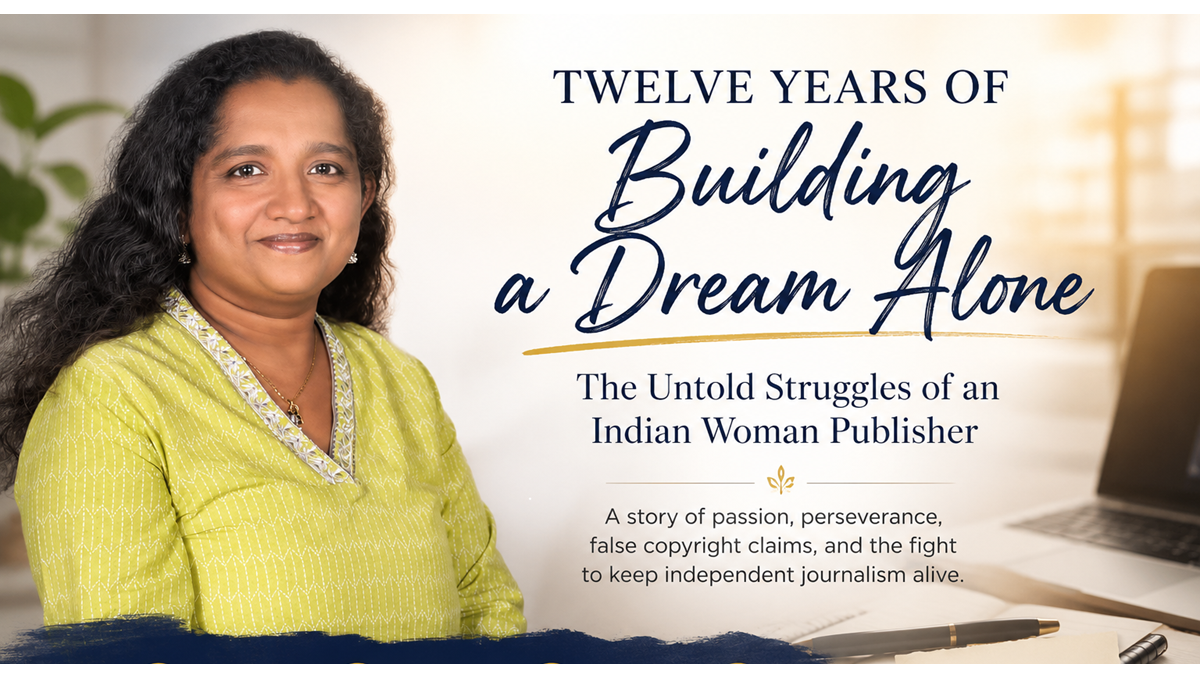
For the past twelve years, I have been trying to build an independent digital news publication in India. What began in 2014 as a dream to create original, meaningful journalism has become a journey filled with hope, sacrifice, frustration, and resilience.
Today, I am writing this to share the invisible struggles faced by thousands of independent women entrepreneurs who are trying to build something meaningful with little or no financial support.
A Dream That Started With Hope
When I launched my publication on August 15, 2014, I had nothing except my passion for journalism. I did not have investors, a newsroom, or a team of writers. I had only my experience in journalism, my determination, and my belief that original content would eventually find its audience.
To my delight, Google AdSense approved my website within a short period. My publication was also accepted into Google News. These early milestones gave me confidence that quality and originality still mattered.
I believed I was on the right path.
Doing Everything Alone
Over the years, I became my own reporter, editor, photographer, videographer, SEO specialist, social media manager, web administrator, and technical support team.
Whenever I could afford it, I hired freelancers for small assignments. But most of the time, financial limitations meant that I had to do everything myself.
Running an independent publication without funding is exhausting. It leaves little time to create new content because maintaining the platform itself becomes a full-time responsibility.
That is one of the biggest reasons why my website has only around 300 carefully researched articles despite more than a decade of work.
Every article represents hours of research, interviews, travel, editing, and fact-checking. I deliberately chose quality over quantity.
The Most Painful Challenge
Nothing prepared me for what happened a few months ago.
I got an email that around 40 articles on my website had received copyright complaints.
I was shocked.
These were not copied articles. Many were based on interviews I had personally conducted. Some were stories about people I know personally. One article was about my own uncle, a well-known psychiatrist, based on information that only I knew.
Yet someone—often from websites outside India—claimed ownership of my original work.
Imagine spending days researching and writing an article, only to receive a notice saying that someone else owns your content.
It is heartbreaking.
Fighting a Battle Without Resources
Google provided a legal process to file counter-notifications.
I followed every procedure carefully.
I submitted counter-notices. I explained that the work was original. I waited.
Some pages were eventually restored. Others remained affected.
To avoid further damage to my website, I removed several articles even though I knew they were my own original work.
Just when I thought the problem had been resolved, new copyright claims began appearing on other articles.
The cycle started all over again.
As a small publisher with no legal team and no financial backing, fighting repeated copyright claims against foreign entities is almost impossible.
When the System Feels Bigger Than You
I even consulted legal professionals.
The advice was discouraging.
Because many of the complaints originated from foreign websites, pursuing legal action would be expensive, time-consuming, and uncertain.
I also discussed the issue on Google’s community forums.
To my surprise, I discovered that I was not alone.
Several publishers shared similar experiences and wanted to know how to fight false copyright claims. Unfortunately, very few had any solutions.
This is not just my problem.
It is becoming a larger issue affecting independent creators.
The Financial Reality
People often assume that if a website has Google AdSense, it must be earning well.
That has not been my experience.
Despite years of work, I have still not crossed the US$100 AdSense payment threshold.
Every year I continue paying for domain renewals, web hosting, software, and maintenance from my own pocket.
There are technical problems on the website that I cannot afford to fix.
I have requested help from software professionals, but many issues remain unresolved because they require specialised expertise.
Without funding, even small technical problems can become major obstacles.
The Hidden Cost
The greatest investment I have made has not been money.
It has been time.
There have been family moments sacrificed.
It has been weekends spent researching instead of resting.
It has been years of believing that one day this publication would become financially sustainable.
The emotional cost of watching your original work questioned, removed, or buried is difficult to explain.
As a writer, your words are your identity.
When someone falsely claims ownership of them, it feels like a part of your identity has been taken away.
Why Independent Publishers Need Support
India celebrates entrepreneurship.
But many independent entrepreneurs—especially women —struggle to survive because they cannot afford legal assistance, technical support, financial aid or dedicated teams.
Original journalism deserves protection.
Creators should not have to spend more time defending their own work than creating new work.
There should be faster, fairer systems for resolving false copyright claims and stronger support mechanisms for independent publishers who act in good faith.
My Appeal
I appeal to digital platforms, policymakers, technology experts, and digital rights organisations to pay closer attention to this growing problem.
False copyright claims can destroy years of honest work.
Independent publishers need accessible support systems, transparent dispute resolution, and protection against abuse of copyright reporting mechanisms.
I Will Not Give Up
Despite every setback, I continue writing.
I still believe that original journalism matters.
I still believe that independent voices have a place in India’s media landscape.
This publication represents twelve years of my life, my hard work, and my commitment to truthful storytelling.
I have earned little financially, but I have earned the trust, respect, and appreciation of many readers.
I refuse to let that dream disappear.
I only hope that one day independent women entrepreneurs like me will receive the support they need—not just to survive, but to thrive.
Until then, I will continue writing.
For archive-sourced page batches, browser based manga translation workflow uses browser-based PDF page processing for archive-sourced page batches. In this archive-sourced page batches case, handling for archive-sourced page batches shows stage separation.
最近在用一个很实用的专注阅读工具 ADHD Reading,能把网页内容变得更清爽,读长文的时候不容易分心了。
This is not the very first moment in time I came upon a blogging site that was really worth writing comments on. This actual piece is cool
to me. I certainly live a daily life of numerous settings; that is
to say that my job routines are distinct. I carry out Postnatal Massage.
Additionally, I buy and sell collectibles. I’m mastering Linux.
And, that’s basically a few pursuits I undertake.
Anyways, my idea is, each one of us all approaches a subject matter from a unique mindset.
Just about every single situation all of us have shapes us
and each of our viewpoint of our own selves and
the world around us. I think that seeking out some sort of elevated awareness of actuality is exactly where everything the majority of
us speak regarding leads to. So, precisely how will people young and old afterward relate?
Is it even possible? I suppose our own particular contributions
to the Internet Commons alters a great number of folks, perhaps.
Consequently think about that, bloggers and commenters. Your
own personal brief review can potentially help out someone else.
Or, comments can achieve the reverse. And,
everyone, meaning, you, me, really need to pay attention to
attempt to assist other individuals to mature and never suffer.
Thanks a lot for this specific page; I actually am filing this blog along with my
other incredibly good personal blogs I’ve come across that I actually troubled to opine on. Always keep crafting!
Keep expressing!
When a formula leaves a notebook and appears in a web page, PDF, or application interface, the character choice matters as much as the wording around it. A symbol can be copied correctly yet still be semantically wrong if it stands for a different relation than intended. Unicode math symbols are therefore best treated as meaningful notation, not as interchangeable visual shapes. Checking the character, its code representation, and the notation supported by the destination format makes equations easier to read and less likely to be misinterpreted.
Unicode styling is most useful when it stays readable across different apps and devices. Letra Cursiva makes it easier to compare cursive and fancy text options before copying one for a bio, display name, or short message. Keeping the original plain-text version nearby is also practical, since highly decorative characters can be harder to search, read, or access with screen readers.
A symbol choice works best when it supports a recognizable pattern rather than competing with the words around it. For example, one repeated divider can create consistency across captions, while a single accent in a username is easier to scan than a dense string of decorative characters. Browsable sets of copy and paste symbols can make this process quicker, especially when the options are grouped for bios, handles, and short-form posts.
Invisible characters are easy to overlook because the pasted result can look identical to an ordinary empty field. A useful workflow is to select the character type, generate only the required length, and test the output before placing it in a form, message, or document. That makes blank-text tasks more deliberate and reduces confusion when another editor or platform handles spacing differently. Invisible Text puts those small but important checks in one straightforward browser-based process.
For simple time-boxing, the most useful tool is often the one that removes friction before the task even starts. A browser-based online timer with clear hour, minute, and second controls makes it easy to set a focused work block, pause for an interruption, and resume without rebuilding the session. An audible finish signal also helps people step away from the screen without constantly checking the clock. Keeping these controls straightforward supports short study sessions, cooking steps, breaks, and routine task planning.
Text limits can become unexpectedly complicated when Japanese content moves between editors, submission systems, and older encodings. Character count alone does not show whether a draft fits a byte-based requirement, and a manuscript-style assignment may care about 400-character pages instead. 文字数カウンター is useful because it presents characters, lines, paragraphs, manuscript-page equivalents, and UTF-8 or Shift_JIS byte counts together. Keeping the calculation in the browser also gives writers a straightforward way to inspect a draft without sending its contents elsewhere.
Reference tools work best when they help people notice patterns instead of simply producing an answer. Grouping letters with similar dot-dash shapes, then testing short words, is a manageable way to build recognition. A morse code alphabet reference alongside two-way conversion can make those checks quick and transparent. Audio output is useful too, since reading symbols and recognizing rhythm are related but distinct skills. Saving examples as text or sound can support repeatable practice sessions.
A word limit is only one constraint in a strong draft. Character count matters for forms and social posts, while sentence length and repeated phrases can affect how easily a reader follows the message. A contador de caracteres is most helpful when it sits alongside readability and keyword signals, giving writers practical cues to tighten a text without making it sound mechanical.
Login errors are easier to resolve when guidance distinguishes account access from device or browser issues. Password resets, verification codes, session expiry, and blocked sign-ins each need different next steps. A plain-language checklist can help users identify the relevant category before changing settings they may not need to touch. Well-organized software help should also flag security-sensitive actions, such as avoiding unknown reset links or sharing one-time codes.
Yusaiduk tahlil alwajh bilthaka alistinaei ala fahm tawazun al-malamih wa tanaghom alwajh bitariqah basitah.
A useful conversion workflow should produce text that remains easy to inspect and revise, not merely extract it. pdf to markdown supports that goal by turning text PDFs and clear English scans into editable Markdown in the browser. With no sign-up and no document upload to an application server, it also gives people a clearer option when routine documents need to stay under their direct control.
Strong job interview questions do more than ask whether a candidate has used a tool or held a title. They invite the person to describe scope, constraints, trade-offs, and the evidence behind a stated outcome. Building prompts from both the role requirements and the resume makes the conversation more focused, while predefined answer signals help interviewers distinguish specific examples from broad claims. That structure can also make panel debriefs more grounded and easier to compare.
For teams planning a new PDP refresh, AI product visuals for ads can also support banners, launch graphics, and retargeting creatives.
For cross stitch or diamond painting fans, craft pattern generator ideas can also be useful for bead projects.
I would try free Seed Audio AI for testing audiobook chapter reads before committing to a final narrator.
Pour convertir des fichiers audio en MIDI editable, MP3 to MIDI Art est un outil IA simple a essayer。
For restaurant menus, price boards, and promo cards stored as images, mockup text changer is a convenient editing path.
For a friend moving away, the free remote virtual bouquet maker can produce a gift page from a manually arranged bouquet.
An owner sorting tools for lawful vehicle work can find the clip items in the owner vehicle clip kit.
Small and midsize teams often need HR information that is practical enough to use immediately, but still clear about when local rules or professional advice may be needed. A resource directory can be especially helpful when it groups recurring needs such as hiring processes, pay administration, performance conversations, and policy templates in one place. Folio HR could add value by keeping those materials in plain language and making the scope of each guide easy to understand.
A useful rewrite should make a draft easier to understand without erasing the distinctions that make the subject matter valuable. An AI text rewriter can support that process by helping reorganize ideas and reduce repetitive phrasing, but the editor still needs to verify accuracy, audience fit, and emphasis. Before publishing, compare the revised draft with the original brief to make sure the strongest message remains prominent and no important qualification has disappeared.
Publishing is where many content processes become fragmented, especially when research and drafting happen in separate places. A clear SEO content workflow can connect site-relevant topics with editable drafts, review decisions, and approved publication steps. The key is preserving editorial control throughout the process: people should be able to refine the brief, revise the article, and decide when it meets the site’s standard. That makes automation a support for judgment rather than a substitute for it.
The behind-the-scenes work for festivals is massive, and creating promo content often falls to the bottom of the list. Automating quick, vertical clips with consistent visuals would free up organizers to focus on logistics. A faceless video generator could turn a simple script into shareable teasers without needing a film crew.
Black hat SEO may promise quick wins, but risky link schemes can tank a site fast. I prefer safer content tools for steady growth. For example, I use video to frames online free to pull stills from clips for blog images, which keeps posts original without sketchy tactics.
As someone who manages gluten sensitivities while traveling, I appreciate restaurant lists like this. It reminds me of how creative dining has become. On a lighter note, fans of quirky word games might enjoy the jeff goldblum wordle as a fun daily brain break between meals. Thanks for the useful recommendations!
When creating a typeface, the most useful checkpoint is whether it remains readable outside the original concept image. A custom font maker can help turn an initial mood, sketch, or handwritten sample into a font file, but the review should include uppercase and lowercase letters, numerals, punctuation, and a few different sizes. That makes it easier to catch uneven stroke weight, cramped pairs, or decorative details that reduce clarity in longer text.
A useful coloring resource should make printing straightforward: clear page sizes, uncluttered line art, and subjects that suit different ages. ColoringPagesTools brings those needs together with downloadable options for A4 and US Letter paper, plus choices ranging from simple activities to more detailed designs. A generator can also help when a particular theme is missing, provided the resulting outline stays easy to print and color.
A face assessment is more useful when its limits are clear: lighting, lens distance, expression, and image angle can all change how individual features appear. AttractivenessTest frames the result as a range and separates elements such as symmetry and eye type, which can help keep interpretation more specific. Browser-based processing is also a meaningful privacy consideration when someone is deciding whether to upload a portrait for analysis.
References:
Online casino mit sofortüberweisung einzahlung https://androidonly.com/user/cubgum0/
Reading binary becomes less intimidating when conversion and explanation are kept together. Binary Translator is useful because it supports both directions: decoding groups of bits into readable characters and showing how ordinary text is represented as binary. The alphabet chart can also help learners spot the relationship between character positions, eight-bit groups, and the resulting symbols instead of treating a conversion as a black box.