
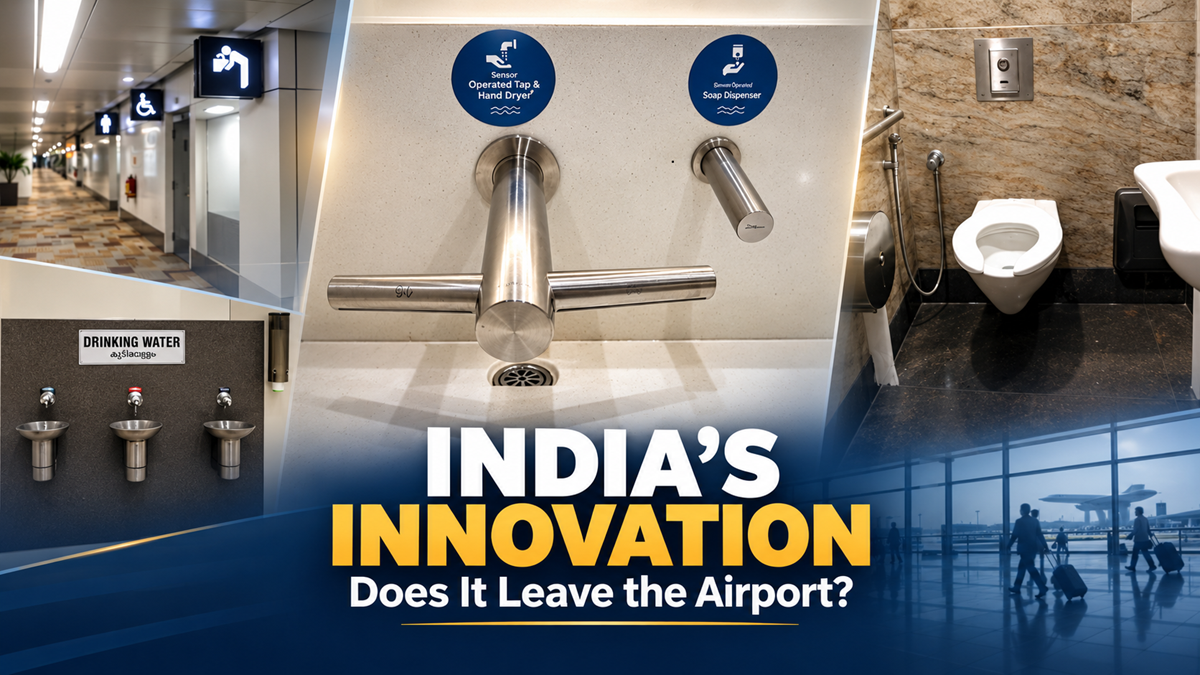
I owe you an apology. Many times, I have complained that there is no innovation in our country. Then I visited Bengaluru’s Kempegowda International Airport and entered its washrooms. That is when I realised innovation is certainly happening in India—at least in some public spaces, especially inside our airports. The sharper question is not whether innovation exists, but why it appears so strongly at airports and so weakly in the everyday spaces where most Indians live.
The washroom had a sensor-operated tap. Place your hands beneath it, and the water flows automatically. Beside it was a sensor-operated soap dispenser, and outlets built into the same unit released air to dry hands. The toilet flushed automatically too.
Everything was sleek, hygienic and thoughtfully designed. For a moment, I felt that India had truly become Vishwaguru. But the deeper point is not the washroom itself; it is what it shows about the standards we can achieve when systems are managed well. Those standards should not remain confined to airports. The real issue is simple: innovation must reach the places where most Indians live their daily lives.
I have not travelled abroad for several years, so I cannot compare the latest facilities in other countries. What I saw in Bengaluru was world-class. It made me feel proud, and it raised a larger question: why does such innovation so often stay inside airports instead of reaching everyday public spaces?
Airports as Showcases of Modern India
Airports are often among the first places international visitors see when they enter India, so they want to make an excellent first impression.
Indian airports now compete to showcase innovation and regional identity. Bengaluru airport has incorporated bamboo and nature-inspired interiors. Cochin International Airport became internationally recognised for its use of solar energy. Delhi Airport has expanded into multiple terminals serving an enormous number of passengers. These examples show how airports have become showcases of modern India.
As of 31 July 2025, India had 162 operational airports, according to the Ministry of Civil Aviation. That means there are at least 10,000 airport toilets that are well maintained 24×7.
These are meaningful achievements. They show what India can accomplish with funding, professional management, institutional accountability and healthy competition. Yet the central question remains simple: why do such standards still spread so slowly beyond airports into everyday public life? The point is not that airports matter less, but that innovation should not stop where most people never benefit.
Why is the same level of innovation not consistently visible outside the airport, where most people live, travel and work?
Once we leave the terminal, we may encounter traffic congestion, poorly maintained roads, inadequate public toilets, unsafe construction and overcrowded public spaces. That contrast matters because development is often presented through impressive statistics, new buildings and large infrastructure projects. The real question is simpler: do people experience development through ordinary things—safe roads, clean toilets, reliable public transport, good schools and accessible healthcare? That is where the test of progress begins.
Traffic jams, roads caving in, waterlogging and building collapses leave a stronger mark than colourful stories of development.
Development cannot be measured only by what we build. It must also be measured by how well people can use it in daily life, because that is where innovation either reaches people or remains confined. That is the real test: whether progress stays in showcase spaces or reaches ordinary life.
Innovation Must Reach Public Spaces
If touch-free, hygienic washrooms can be maintained in airports, similar systems can gradually be introduced in railway stations, bus terminals, markets, tourist centres and government hospitals.
The solution does not always have to be an expensive imported system. India can develop affordable and durable technology suited to heavy public use. We have engineers, designers, entrepreneurs and manufacturing capacity. What we need is the determination to direct innovation toward the everyday problems ordinary people face. This is how the airport example can lead to wider public improvement.
A beautifully designed airport washroom is not merely a luxury. It proves that high standards are possible in India. The next step is to make those standards more widely available beyond the airport. The question is whether innovation stays impressive in isolated spaces or becomes part of everyday public life.
Are Tourism Numbers Telling the Full Story?
We frequently hear impressive figures about the growth of domestic tourism. The Ministry of Tourism’s provisional estimate for 2025 records about 413.28 crore tourist visits across India. That is roughly 3 times the population of India (140 crore).
During holidays, roads leading to popular destinations are often jammed. Tourist sites become overcrowded, accommodation becomes expensive and basic facilities struggle to cope with visitors. So the number alone matters less than the experience behind it. The same gap between scale and experience appears in how we talk about tourism growth.
A middle-class family may spend ₹20,000 or ₹30,000 on a domestic holiday. We should ask what kind of experience they receive for that money. Do they have safe transport, clean public toilets, transparent pricing and well-managed destinations? If given an option to visit a foreign country for the same price will they travel abroad or tour in India?
Domestic tourism in India is often less about luxury and more about families finding time to be together. Years later, people may not remember every monument they saw, but they remember travelling, eating and laughing together.
That emotional value is important. However, it should not excuse poor infrastructure or inadequate services.
Tourism innovation should focus not only on attracting more visitors but also on improving their experience. Better crowd management, reliable public transport, clean facilities, accessible information and protection against overcharging would make travel more enjoyable and dignified. That same logic applies as we move from tourism to air travel and jobs.
A Full Flight Does Not Always Mean Greater Prosperity
India’s scheduled domestic airlines carried approximately 16.69 crore passengers in 2025. These are passenger journeys, not 16.69 crore unique individuals. A person making a return journey is counted twice, and frequent flyers are counted on every trip.
Crowded airports and full flights are sometimes presented as proof that the Indian middle class has become more prosperous. That may be partly true, but it is not the whole story. The same caution applies when we look at job numbers and employment claims.
On my flight from Bengaluru to Kochi, I saw many migrant workers. Many migrant workers and salaried employees may choose air travel not as a luxury but because they cannot afford to lose two or three days travelling by train.
For them, flying can be a balancing act between ticket price and the wages or leave days they may lose on a longer journey.
Passenger numbers should be interpreted carefully. A full aircraft does not automatically mean that every passenger is travelling comfortably or has become financially secure. The same caution matters as we move into the employment debate, where headline numbers can also mislead.
Qualified Job Aspirants Versus the Jobs Available
India’s employment debate also suffers from confusing headline numbers. No single official national figure neatly divides all job aspirants into “qualified” and “unskilled” categories.
The India Skills Report cited by the government put graduate employability at 54.81% in 2024. Roughly 45% of those assessed did not meet the report’s employability benchmark at that time. This is an assessment-based indicator, however, and should not be treated as a census of every graduate or jobseeker in India.
Meanwhile, the ILO’s India Employment Report 2024 warns that educated young people experience higher unemployment, reflecting a mismatch between their qualifications, aspirations and the jobs available. India can therefore have vacancies and unemployed graduates at the same time: the location, salary, working conditions or required skills may not match. This is why the scale of the challenge matters, and the next figures need context. That context becomes clearer when we look at workforce size.
The scale of the challenge is enormous. The Economic Survey estimates India’s workforce at about 56.5 crore and says the economy needs to create nearly 78.5 lakh non-farm jobs every year until 2030 to absorb the growing workforce. This means the real divide is not simply between “qualified people” and “unskilled jobs.” India faces several mismatches at once:
- a large supply of informal, low-paid or insecure work; and
- workers whose experience is valuable but not formally certified.
Where Are India’s Job Markets Growing?
India does not have one job market. It has several markets growing at different speeds and requiring very different levels of education and training.
The important issue, then, is not merely whether jobs are being announced. We must ask what kind of jobs they are, what they pay, whether they provide security, and whether Indian workers are being prepared to perform them. So the central question remains the same: are our innovations improving everyday life, or are they staying limited to showcase spaces?
Are Our Innovations Improving Everyday Life?
India is building airports, highways, data centres and digital infrastructure. These are important investments. But the real test of progress is whether people feel the benefits in homes, schools, workplaces and neighbourhoods, where most Indians live. In the end, that is the measure of innovation: whether it leaves the airport and reaches everyday India.
If people see innovation only when they enter an airport, a premium restaurant or a corporate office, then its reach remains limited.
The same question applies to the jobs new data centres and technology investments are expected to create. Are our children receiving the education and training required for these opportunities?
Announcing new investments is only the first stage. Education, vocational training, apprenticeships and industry-ready skills must grow alongside them. Otherwise, the buildings may be located in India while the best opportunities remain out of reach for many Indians. The final question is simple: does development stop at the terminal, or does it reach people’s everyday lives?
Let Development Continue Beyond the Terminal
“Atithi Devo Bhava”—the guest is like God—is an important Indian value. We want foreign visitors to have an excellent experience when they arrive.
But what happens after they leave the airport?
Do they see the same cleanliness, safety, efficiency and thoughtful design on our roads, in our public facilities and at our tourist destinations? More importantly, do Indian citizens experience those standards in their daily lives?
India can innovate. Bengaluru airport and many other modern facilities prove that. The real challenge is to carry that innovation beyond the terminal and into everyday life. The real question is whether that innovation reaches beyond the terminal and improves everyday life for ordinary Indians.
What India needs is for innovation to travel further—to railway stations, bus stands, schools, hospitals, public toilets, tourist destinations and ordinary neighbourhoods.
The real measure of development is not the impression created inside an airport. It is the quality of life experienced after we step outside it.
When several tattoo ideas compete for the same area, a simple visual plan can reveal conflicts that are hard to notice in a written list. Patchwork Tattoos provides a starting point for comparing scale, orientation, empty space, and the overall rhythm of a sleeve or collection. The resulting concept is best treated as preparation: a tattoo professional can assess how it fits the body, refine the composition, and advise which elements should be simplified for lasting clarity.
This is really interesting, You’re a very skilled blogger. I’ve joined your feed and look forward to seeking more of your magnificent post. Also, I’ve shared your site in my social networks!
Runtime estimates can be misleading when they are read without the connected load. A small network setup and a gaming PC can draw very different power from the same unit, so capacity labels alone do not answer the buying question. A UPS buying guide that separates wattage, expected runtime, surge protection, and battery replacement planning can make the choice much clearer before purchase.
Academic calculators are most helpful when they make the underlying choices easier to understand rather than merely producing a number. A GPA calculator can help students test how course grades and credits affect an academic result, which supports more informed goal setting. Combined with subject pages, notes, syllabus material, and practice questions, these tools can make routine study planning more structured and less dependent on scattered information.
kadıköy petek temizleme fiyatları Kadıköy’de petek temizliği yaptırmak isteyenlere tavsiye ederim. İşlem hızlı ve özenli yapıldı. https://preprodcp.csdev.space/?p=488
kadıköy acil petek temizleme Kadıköy’de petek temizliği için hizmet aldık. Peteklerin ısınması belirgin şekilde düzeldi, teşekkür ederiz. https://dchnew.yes9.co.uk/?p=433
Excellent information! We purchased from a top Tank lifting jack manufacturer last year.
test comment please ignore
Interesting take on India’s innovation story! I used Nano Banana Pro to create some infographics about tech growth trends for a presentation. Great article!
Thought-provoking piece! I visualized some of these innovation stats with grok imagine for my blog. Thanks for the insights!
Good analysis! I made a short explainer video on this topic using Videm Ai to share with my audience. Appreciate the depth here!
Solid reporting! I generated some charts and visuals with GPT Image 2 to accompany a discussion on this. Well written!
Interesting perspective! I created a visual summary with higsfield.pro for my newsletter on Asian tech trends. Thanks!
Great read! I put together a video recap using pixverseai.pro to highlight the key points. Nice work!
That was amazing
The article’s question about whether India’s innovation actually leaves the airport feels especially sharp when it notes that shiny new terminals and metro lines can coexist with uneven access to reliable electricity or clean water in nearby neighborhoods. That gap matters because infrastructure spending only improves everyday life if it translates into skilled jobs for Gen Z, not just showcase projects for visitors. The piece rightly avoids assuming that tech hubs automatically lift the wider workforce. For a similar contrast between polished spaces and real-world output, hotel lobby ai captures that same tension.
When an app fails, people often need a short path from the symptom to a practical next step: what to check first, what information matters, and when a problem is likely account-related rather than device-related. Clear app troubleshooting can reduce guesswork by separating login, download, and export issues into simple checks that readers can follow without technical jargon.
For small and midsize teams, the practical challenge is turning broad people-management advice into repeatable routines: clear hiring steps, payroll checks, documented performance conversations, and compliance reminders that do not depend on one person remembering everything. A useful resource collection should make those workflows easier to understand and adapt, especially for managers without dedicated HR support. Folio HR brings together plain-English material across these areas, which can help teams compare options and build a more consistent operating baseline.