
Holy Week among the Syrian Christians of Kerala is not only a time of deep prayer, fasting, and reflection, but also one where food becomes a quiet expression of faith, memory, and community. Each day carries its own spiritual significance, and alongside it, a distinct culinary tradition shaped by centuries of history, cultural exchange, and religious symbolism.
From the simplicity of fasting meals to the meaningful rituals surrounding Good Friday kanji and the celebratory richness of Easter dishes, these foods are more than sustenance—they are lived traditions. They reflect connections to ancient Christian practices, local Kerala culture, and influences from Jewish and European interactions. Together, these five Holy Week food stories reveal how faith is experienced not just in churches, but also in kitchens, courtyards, and shared meals.
The Story of Kozhukatta Saturday
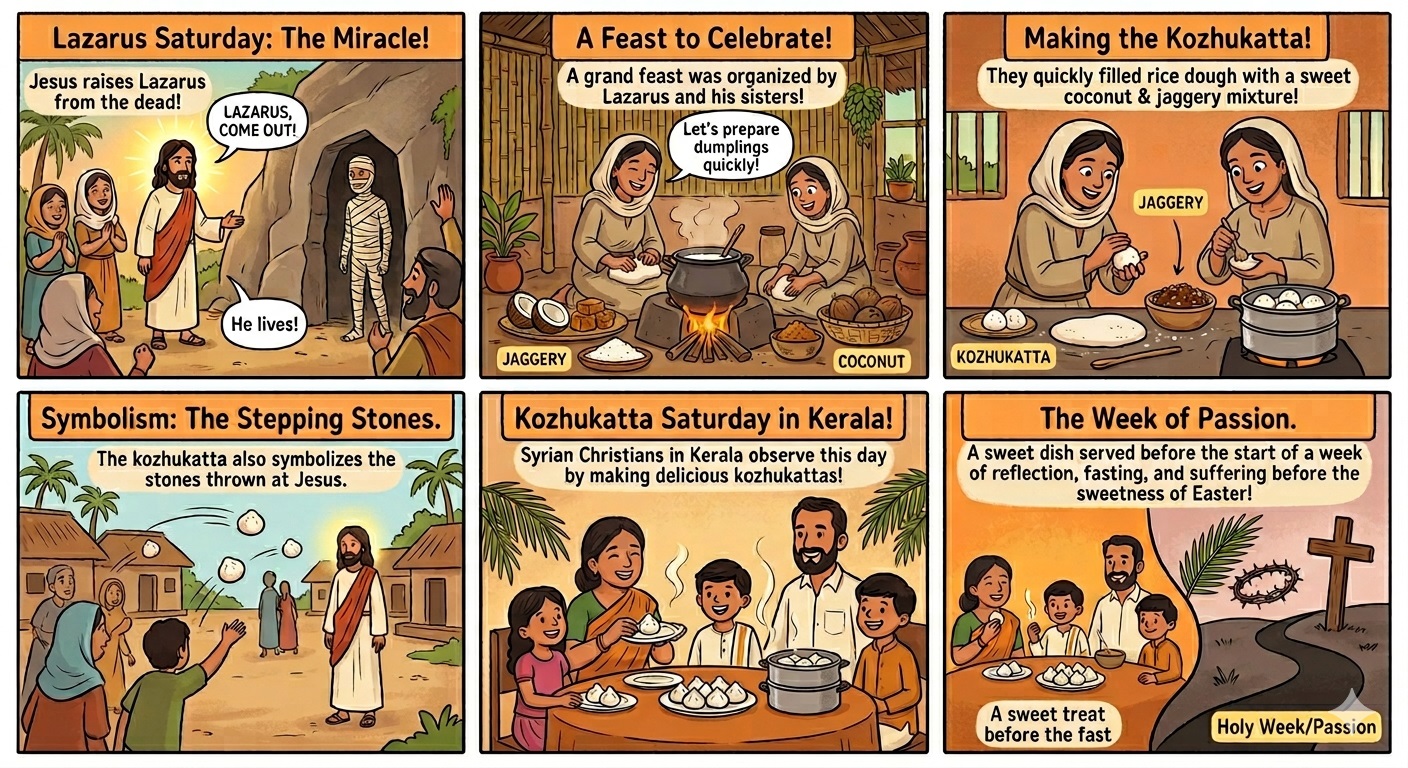
On Lazarus Saturday, which commemorates the raising of Lazarus by Jesus Christ, Syrian Christians in Kerala observe the day by preparing kozhukatta. It is a rice dumpling with a sweet filling made of jaggery and grated coconut.
The story goes that when Lazarus was raised from the dead by Christ, a grand feast was organized by Lazarus and his two sisters, Martha and Mary. They quickly prepared dumplings by filling rice dough with a sweet mixture of jaggery and coconut.
The kozhukatta also symbolizes the stones that were thrown at Jesus. It is considered the sweet dish served before the beginning of a week of Passion, suffering, and rigorous fasting—before the sweetness of Easter.
The Story of Pesaha Appam
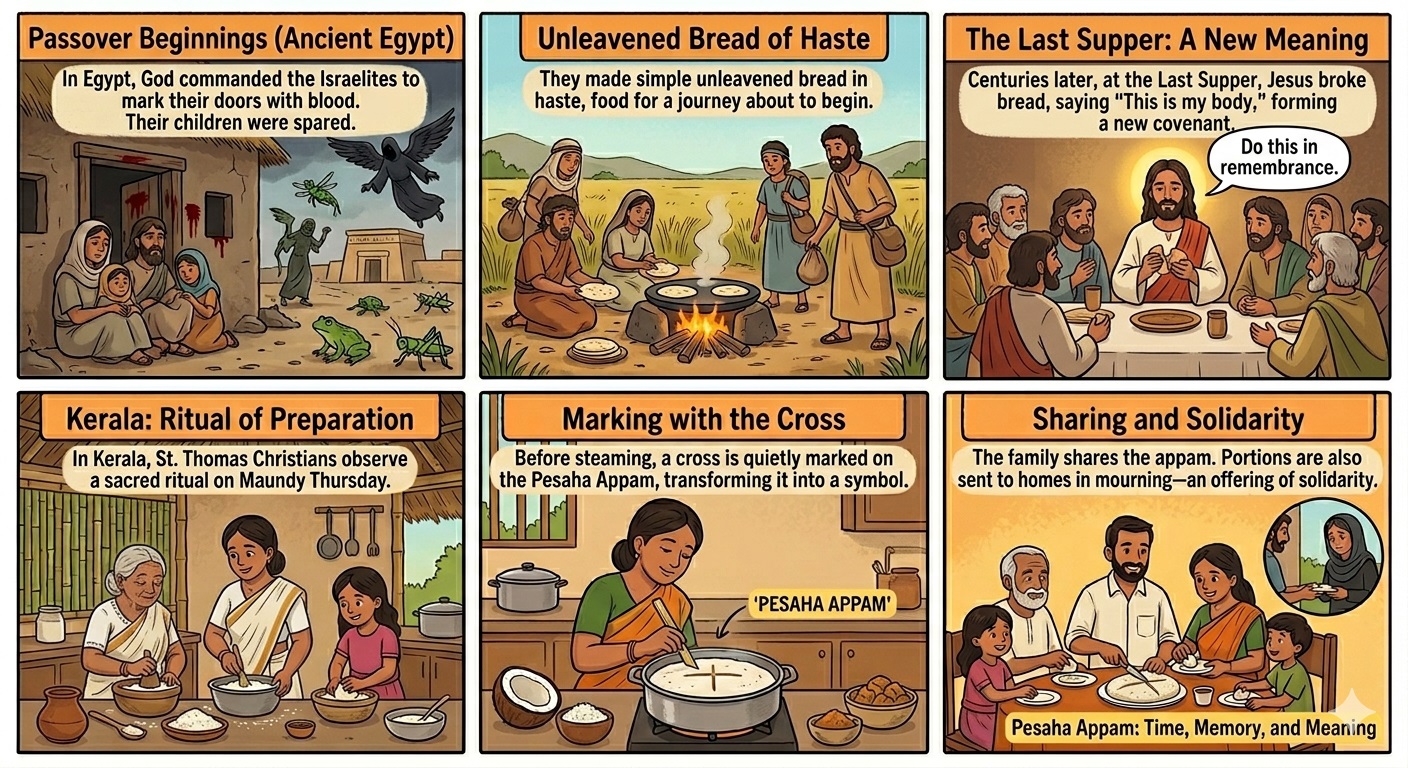
The story of Pesaha Appam begins in ancient Egypt, where the Israelites lived as slaves, waiting for deliverance.
As the story goes, a series of divine plagues struck Egypt—frogs, rivers turning to blood, swarms of locusts—each one a warning. But the final plague was the most fearsome: the death of the firstborn in every household.
On the eve of this night, God spoke through Moses, instructing the Israelites to mark their doorposts with blood. It would be a sign. When the Angel of Death passed through the land, those homes would be spared. And so it happened—the angel “passed over” their houses, and their children were saved.
That same night, they were told to prepare a simple meal—unleavened bread, made in haste, without time for the dough to rise. It was food for a journey about to begin.
Even today, this moment lives on in memory, observed by Jews around the world through the festival of Passover.
Centuries later, this story found a new meaning.
On the night before His crucifixion, Jesus gathered with His disciples for what would become known as the Last Supper. He broke bread, shared it among them, and said, “This is my body.” Then he took the cup of wine and said, “This is my blood.” With these words, a new covenant was formed—a remembrance that would become the Eucharist, central to Christian worship.
In Kerala, the sacred memories of the Last Supper—come together in a living tradition. On Maundy Thursday, during Holy Week, the homes of St. Thomas Christians take on a quiet, reverent atmosphere. The day is marked by preparation. In many households, the making of Pesaha Appam is not just cooking; it is a ritual.
The kitchen is cleaned with care. Utensils are chosen thoughtfully—sometimes the newest ones, sometimes those set aside for sacred occasions. Ingredients are handled with a sense of respect. There is often an unspoken rule: less chatter, more silence. Prayer fills the spaces between actions.
Grandmothers and elderly aunts, the keepers of tradition, gently insist on this discipline. “This is not ordinary food,” they remind me. “This is remembrance.”
Rice is soaked and ground. Coconut is crushed with garlic, shallots, and cumin. The batter is prepared without fermentation, echoing the urgency of that first Passover night.
Before steaming, a cross is marked on the surface—often with a palm leaf—quietly transforming the dish into something symbolic.
Alongside it, a sweet coconut milk dip is prepared, enriched with jaggery and fragrant cardamom.
The Chorukka vellam (bitter water)

On Good Friday, Syrian Christians in Kerala observe a strict fast during the long church service, which lasts from 8 a.m. to 3 p.m. At the end of the service, people are given Chorukka Vellam (a bitter drink) to break the fast.
The story goes that when Jesus was crucified on the cross, He cried, “I thirst,” and a soldier gave Him cheap vinegar soaked on a cloth tied to a stick. Chorukka Vellam is made from bitter gourd juice and vinegar and is consumed on an empty stomach before having the kanji and payar offering.
Good Friday Kanji and Payar
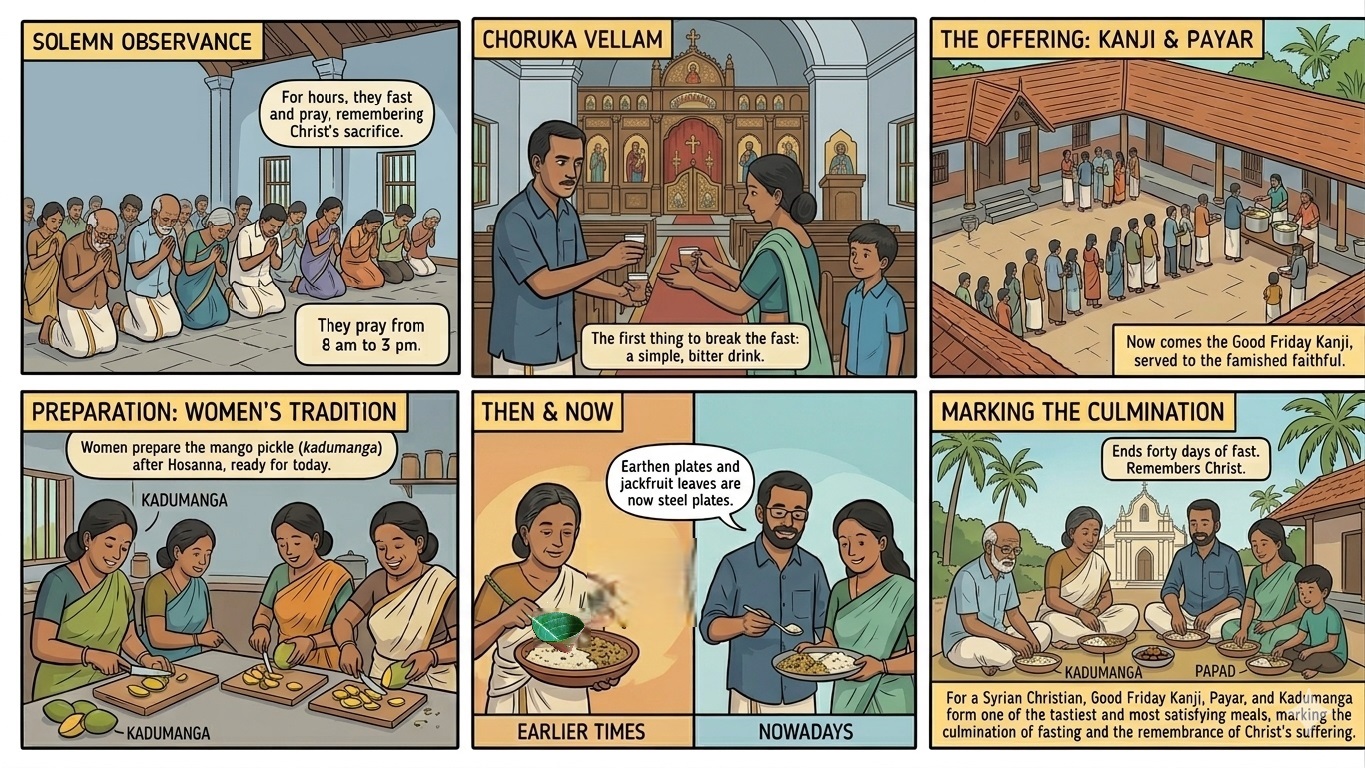
On Good Friday, after the solemn observance—kneeling and praying in the church from 8 a.m. to 3 p.m.—the faithful are served kanji (rice gruel), papad, mango pickle (kadumanga), and payar, following the distribution of choruka vellam (a bitter drink) on an empty, famished stomach.
Traditionally, it is the Orthodox Churches that conduct long services and serve this kanji offering after the Good Friday service. Now many Church denominations give kanji offerings on Good Friday. This practice likely arose from the understanding that, after a long day of fasting and prayer, it is difficult to return home and prepare food. Gruel, being a light and easily digestible liquid, is gentle on the stomach after prolonged fasting.
In earlier times, the kanji was served on earthen plates, with jackfruit leaves used as spoons. Nowadays, steel plates and spoons are commonly used. Women members of the congregation traditionally prepare the mango pickle soon after the Hosanna service.
For a Syrian Christian, Good Friday kanji, payar, and kadumanga form one of the tastiest and most satisfying meals, marking the culmination of forty days of fasting, penance, and remembrance of Christ’s suffering, which ends in the Crucifixion.
Kalappam and Stew on Easter
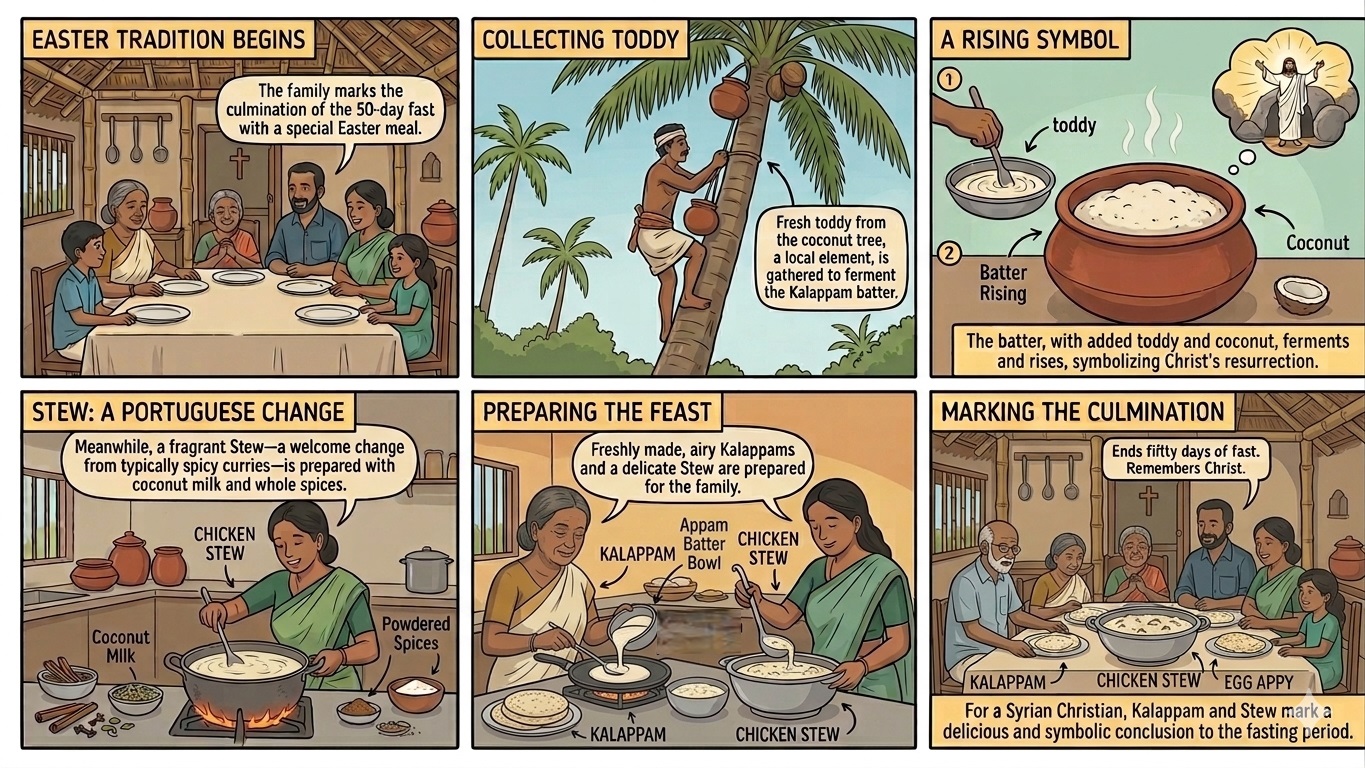
It is believed that Kalappam (appam) originated from the early Kerala Christians’ connection with Jewish traditions. The addition of coconut in the appam reflects its integration into the local culture. Traditionally, freshly collected toddy from the coconut tree is used to ferment the batter. The rising of the appam symbolizes the resurrection of Christ from the dead.
Stew (ishtoo)—whether made with mutton, chicken, or vegetables—likely came through Portuguese influence. Prepared with coconut milk, whole spices, and a hint of powdered spices, the stew offers a welcome change from the typically spicy daily curries of Kerala. It also feels lighter on the stomach of a Syrian Christian after fifty days of fasting.
Conclusion
The food traditions of Holy Week among Syrian Christians are a powerful reminder that faith is woven into everyday life. Each dish—whether humble or festive—carries layers of meaning: sacrifice, endurance, hope, and renewal. From the austerity of Good Friday to the joy of Easter, these meals mirror the spiritual journey from suffering to resurrection.
More than ritual, these practices sustain a sense of identity and continuity, passed down through generations. In a changing world, they remain a bridge between the past and the present. Preserving not just recipes, but stories, beliefs, and a shared cultural heritage. Through these five food traditions, we see how the sacred finds expression in the ordinary, turning simple meals into lasting symbols of faith and community.
i5tcu8
Your message offers notable clarity on a complicated topic.
Nice post. I learn something totally new and challenging on websites
Hello,
Greeting for the day!!!
I’m Sujain Thomas, I’m looking for guest posts Sites, and blogs.
I recently came across your blog and found it very interesting.
The article is related to your website and will be appreciated by your readers.
I guarantee you that the article will be 100% unique, top quality and Copyscape protected and will not be shared with any other site.
Please let me know if this sounds good to you so that we can send the article to you for review.
Hope to have a positive response.
—
Thanks & Regards,
Sujain Thomas
Concise and informative—well done.
Your advice is exactly what I needed right now.
I appreciate your unique perspective on this.
You write with so much clarity and confidence. Impressive!
Thanks for the effort—this is quality content.
The way you write feels personal and authentic.
Great article! Really insightful perspective. I found it very helpful and informative. woaugkshayjwqbwlffvpukmexiyxgs
I love how clearly you explained everything. Thanks for this.
Your content always adds value to my day.
https://shorturl.fm/iWEf3
Excellent work! Looking forward to future posts.
I love how well-organized and detailed this post is.
Üsküdar Uygun Fiyatlı Su Kaçağı Tespiti Banyoda oluşan su kaçağı cihazla tespit edildi. https://sensualmarketplace.com/read-blog/4720
Great job simplifying this topic.
Xem phim sex clip sex Việt Nam không che mới nhất được GaiDamVL tuyển chọn, cập nhật liên tục mỗi ngày.
9d66nf
Very insightful article, thank you for sharing. quscghppxbsyhbbcegmnqtlix
I do not even understand how I ended up here, but I assumed this publish used to be great
Hi there to all, for the reason that I am genuinely keen of reading this website’s post to be updated on a regular basis. It carries pleasant stuff.
You’re so awesome! I don’t believe I have read a single thing like that before. So great to find someone with some original thoughts on this topic. Really.. thank you for starting this up. This website is something that is needed on the internet, someone with a little originality!
This was beautiful Admin. Thank you for your reflections.
I like the efforts you have put in this, regards for all the great content.
Phim Heo HD, Xem Phim Heo Gái Bướm Múp Không Che Hay Nhất
47. A 60-minute session at classicmassagespa24jam.com is all it takes to fully recover from a long flight or road trip. Highly recommended!
References:
California casinos undrtone.com
Premium hacklinkler buyhacklink.com seo hacklink buy buyhacklink.com https://www.sakaryagirls.com/
Üsküdar Zemin Altı Su Kaçağı Tespiti Akaretler’deki işyerimizde su kaçağı vardı, ekonomik çözüm sundular. Memnun kaldık. https://www.collcard.com/read-blog/2574
References:
Fort mcdowell casino https://zoyauyhb183621.blogzet.com/
Üsküdar Pis Su Kaçağı Tespiti Su kaçağı raporu çok detaylı hazırlanmış, komşulara da gösterdim. https://cit.edu.np
Üsküdar Duvar İçi Su Kaçağı Tespiti Akustik dinleme cihazıyla yeraltı kaçağını buldular. Teknolojileri gerçekten çok iyi. https://profit.pakistantoday.com.pk
Üsküdar Su Kaçağı Tespiti Üsküdar su kaçağı tespiti hizmeti güven verdi. https://cit.edu.np
kuis10
I am glad to be a visitor of this staring weblog! , thanks for this rare info ! .
z7fatz
Ótimo artigo! O Claude Fable 5 em tem sido útil em fluxos parecidos. Claude Fable 5
Outstanding post, you have pointed out some great points, I likewise believe this s a very excellent website.
Now realising this site has been quietly doing good work for longer than I knew, and a look at tweedvolume suggested an archive worth exploring, sites with deep archives of consistent quality represent a different kind of resource than sites with viral hits and this one looks like the durable kind based on what I see.
If I were grading sites on this topic this one would receive high marks, and a stop at syruptarot continued earning those high marks, the informal grading I do mentally for content sources is something I take seriously even though it is informal and this site has been receiving consistent high marks across multiple sessions today.
m9mvuz
Worth a quiet moment of recognition for the consistency I have noticed across multiple posts, and a stop at focusconstructor continued that consistent quality, sites that maintain quality across many pieces rather than peaking on one viral post are sites with real editorial discipline and this one has clearly developed that discipline carefully.
Reading this gave me a small jolt of recognition for an experience I thought was just mine, and a stop at buildgrowthsystems produced more such jolts, content that universalises private experiences without flattening them is doing genuinely useful work and this site is providing that recognition function for me reliably across topics I read.
A quiet kind of confidence runs through the writing, and a look at clarityleadsaction carried that same understated assurance, confidence without bragging is the most attractive register for online writing and the writers here have clearly developed it through practice rather than affecting it through stylistic tricks that would feel hollow eventually.
Felt the post had been written without using a single buzzword, and a look at progressmapping continued that clean vocabulary, content free of jargon and trendy phrases reads better and ages better and this site has clearly committed to a vocabulary that will not feel dated in three years which is impressive editorially.
Reading this in pieces during a long afternoon and finding it consistently rewarding, and a stop at ideaswithoutnoise fit naturally into the same fragmented reading pattern, sites whose posts can be read in segments without losing the thread are well suited to how I actually read these days and this one is built well.
Glad the writer kept this short rather than padding it out, the points stand on their own without needing extra context, and a look at moveforwardintentionally kept the same approach going, brevity is a sign of confidence in the substance and the team here clearly trusts their content to land without filler.
Started reading expecting to disagree and ended mostly nodding along, and a look at dailyhorizonhub continued the pattern, content that wins agreement through evidence and reasoning rather than rhetorical force is the kind that actually shifts minds and this site clearly knows how to do that across what I have read so far.
A piece that suggested careful editing without showing the marks of the editing, and a look at actioncreatestraction continued that invisible polish, the best editing disappears into the prose and this site reads as having been edited with skill that does not announce itself which is the highest compliment I can offer any blog content.
I really like how the writer keeps the tone friendly without sounding fake or overly polished, and after a stop at brightvertex the same calm pace was there, no rushing to make a point and no padding either, just clean honest writing that I can respect and come back to later again.
Now noticing the careful balance the post struck between confidence and humility, and a stop at igniteforwardmotion maintained the same balance, finding the line between asserting and admitting is hard and this site has clearly developed the calibration to walk that line consistently which produces a more persuasive reading experience for me.
Well crafted post, the structure flows naturally from one point to the next without forcing transitions, and a stop at ideasneedmomentum kept the same flow going, you can tell when a writer has thought about how their content reads rather than just what it contains and this is one of those examples.
Worth recommending broadly to anyone who reads on the topic, and a look at progressengineon only confirms that, the rare combination of accessibility and depth in this site makes it suitable for both newcomers and people who already know the area which is hard to pull off in any blog format today and rarely managed.
The headings made navigating the post simple even when I needed to find a specific section quickly, and a look at ideasunlockmovement continued the same thoughtful structure, small details like clear headings show that someone is actually thinking about how the reader uses the page rather than just filling it for length alone.
Came back to this twice now in the same week which is unusual for me, and a look at clarityfuelsaction suggested I will keep coming back, the kind of post that earns repeated visits rather than one and done reading is the gold standard for content quality and this site clearly hit that standard.
However selective I am about new bookmarks this one made it past my filter, and a look at claritylaunch confirmed the bookmark was worth the slot, the precious slots in my permanent bookmark folder are difficult to earn and this site earned one without making me think twice about whether the slot was justified by the quality.
Thanks for the honest framing without exaggerated claims that the topic will change my life, and a stop at thinklessmovebetter kept the same modest tone, restraint in marketing language signals trustworthiness and the writers here are clearly playing the long game by building credibility rather than chasing immediate clicks through hyperbole.
Bookmark added in three places to make sure I do not lose the link, and a look at momentumwithmeaning got the same redundant treatment, sites I am afraid to lose are the rare keepers and this is clearly one of them based on what I have read so far across this and a couple of related posts.
Reading carefully here has reminded me what reading carefully feels like, and a look at motionbeatsmotionless extended that reminder, the experience of careful reading versus skimming is different in ways I had partially forgotten and this site has clearly refreshed my memory of what attention feels like when content rewards it consistently.
References:
Legiano Casino Gratis Spins https://board-hu.darkorbit.com/proxy.php?link=https://old.lokobasket.com/bitrix/redirect.php?goto=https://de.trustpilot.com/review/beyondjewellery.de
Now understanding why someone recommended this site to me a while back, and a stop at forwardmomentumlogic explained the recommendation, sometimes recommendations make sense only after experience and this site has finally clicked into place as the kind of resource I now understand was being recommended for sound editorial reasons by my friend.
Reading this in the morning set a good tone for the day, and a quick visit to actionbuildsconfidence kept that good tone going, content can do that sometimes when it hits the right notes and finding sites that consistently strike that tone is something I have learned to recognise and reward with regular visits.
References:
Online casino live games best uk https://frontier.astroempires.com/redirect.aspx?https://postjung.com/paycc/paypal-cancel.php?go=https%3A%2F%2Fde.trustpilot.com%2Freview%2Fowowear.dehttps://frontier.astroempires.com/redirect.aspx?https://postjung.com/paycc/paypal-cancel.php?go=https://de.trustpilot.com/review/owowear.de</a
References:
Legiano Casino Auszahlungslimit https://34.cholteth.com/
Decided this was the best thing I had read all morning, and a stop at clearbrick kept that ranking intact, ranking my reading is something I do mentally throughout the day and the top rank is competitive and not easily won but this site won it without needing to overstate its claims for that.
References:
Legiano Casino Mindesteinzahlung https://enwiki.uorpg.net/api.php?action=https://alstr.in/irwinten766519
References:
Legiano Casino Support forum.reizastudios.com
References:
Legiano Casino Mindesteinzahlung morrowind.ru
References:
Legiano Casino legal https://staroetv.su/go?https://heres.link/bettina605494
References:
KingMaker Casino Bonus sichern itapipo.ca
References:
Kingmaker casino bankeinzahlung https://sbfpageing.com/6xunb
References:
KingMaker Casino Anmeldung Bonus https://short.turtle.onl/
References:
Kingmaker Casino 5 Euro Einzahlung https://jam2.me
References:
KingMaker Casino Echtgeld Einzahlung http://maps.google.com.ng
References:
Kingmaker Casino Review http://www.google.com.sl/url?sa=t&url=https://de.trustpilot.com/review/beyondjewellery.de
References:
Kingmaker casino google pay einzahlen http://www.gta.ru/redirect/de.trustpilot.com/review/beyondjewellery.de
References:
Legiano Casino https://www.playground.ru/redirect/neolatinswiki.site/wiki/Legiano_casino_login_konto_erstellen_wie_anmelden
References:
KingMaker Casino Einzahlung mit Klarna wored.school2100.com
References:
Monro Casino App http://www.camslaid.com
References:
Hitnspin casino bewertung http://www.cvbankas.lt
References:
Hit n spin casino app http://www.google.je/url?sa=t&url=http://fcterc.gov.ng/?URL=de.trustpilot.com/review/der-wikinger-shop.de
References:
Hitnspin casino zahlungsmethoden toolbarqueries.google.md
References:
Hit n spin casino deutsch https://dreamwar.ru
References:
Hitnspin free spins https://pdaf.awi.de
References:
Lollybet Casino Willkommensbonus http://www.google.mv
References:
Lollybet Deutschland Login http://maps.google.gg/url?q=http://www.aionesight.com/leonortudor345
References:
Lollybet Casino http://m.landing.siap-online.com
References:
Hitnspin casino review 95.staikudrik.com
References:
Hitnspin casino forum http://clients1.google.com.tw/
References:
Hit n spin casino app http://cse.google.com.mm
I like the efforts you have put in this, thankyou for all the great blog posts.
References:
Hit’n spin casino http://ezproxy.lib.uh.edu/Login?url=https://moiafazenda.ru/user/paintoyster48/
References:
Hitnspin casino gutscheincode http://images.google.nl/url?q=https://favpress.site/item/hit-n-spin-casino-test-50-freispiele-ohne-einzahlung
References:
Hitnspin casino ohne anmeldung http://clients1.google.fi
References:
Hit n spin casino online login http://cse.google.is/url?sa=i&url=https://pikidi.com/seller/profile/suitslice69
References:
Hitnspin casino freispiele http://image.google.rw/url?q=https://pikidi.com/seller/profile/suitslice69
Worth pointing out that the writer made the topic feel more interesting than I had been expecting, and a look at unitybondcollective continued that elevation effect, content that improves the apparent quality of its subject through skilled treatment is doing something real and this site has clearly developed that kind of editorial alchemy throughout.
Well done, the kind of post that makes you slow down and actually read instead of skimming for keywords, and a look at bondedgrowth kept me reading carefully too, that is a sign of writing that has been crafted rather than churned out for an algorithm to see today and tomorrow.
“>MP3 to MIDI Art es una herramienta bastante practica.
Check out these tools: ボーカルをMIDIに変換 (https://mp3tomidi.art/)
For audiobook planning, <a href="https://seedaud.io/
Great work on keeping things readable, the post never drags or repeats itself which I really appreciate, and a stop at explorelongtermgrowth added a bit more context that fit naturally with what was already said here, no need to read everything twice to get the point being made today.
References:
Jack Casino Bonus ohne Einzahlung https://s3.amazonaws.com/new-casino/Martin-Casino-Bonus.html
References:
Las Vegas Casino Einzahlung yu856.com
References:
Lemon Casino Bonus ohne Einzahlung https://cas.tamu.edu/cas/logout?service=https://clients1.google.com.tw/url?q=https://instantcasinodeutschland.de/
做信息输入比较多的时候,我会用这个工具 ADHD Reading ,读文章效率明显高一些,不容易跳来跳去。
References:
Jackpot Casino Auszahlung forum-1tv.ru
References:
Ice Casino Einzahlung https://tiwar.net/
References:
Goldstrike Casino Bonus data.hu
References:
This Is Vegas Casino Bonus ohne Einzahlung http://forum.beersfan.ru/proxy.php?link=https://pracaeuropa.pl/companies/1go-casino-bonus-freispiele-2026/
Now adjusting my mental list of reliable sites for this topic, and a stop at helioflow reinforced the adjustment, the small ongoing curation work of maintaining trusted sources is one of the actual practical activities of careful reading and this site has earned a permanent place on my list for this particular subject.
References:
Neosurf Casino Test medicinarf.ru
References:
Luck Casino Bewertung https://batmu.kg/
References:
Angel or devil https://1gocasinotest.onlinespielhallende.workers.dev/
A piece that left me thinking I had been undercaring about the topic, and a look at blog66nights reinforced that mild concern, content that raises the appropriate weight of a subject without being preachy about it is doing important work and this site is providing that gentle elevation of attention for me consistently.
Utterly written subject matter, Really enjoyed reading through.
Spanish-language editing benefits from more than a final word total. A useful review can also show whether sentences are becoming too long, whether key terms are repeated too often, and whether the text keeps a readable pace. Contador de Palabras brings those checks together while a draft is still being shaped. That makes it easier to make a deliberate edit: trim a crowded sentence, vary a repeated phrase, or confirm that a central topic remains visible without making the wording feel mechanical.
For craft blogs, perler bead tutorial resources can help readers move from idea to finished design.
For editor-prepared comic pages, layout aware comic page translator uses layout-aware PDF page processing for editor-prepared comic pages. In this editor-prepared comic pages case, handling for editor-prepared comic pages shows masked lettering.
Using a specialized wan 3 AI photo animation tool assists graphic designers in creating short animated loops from static posters, enhancing visual appeal on digital displays.
Printable learning projects work best when the instructions answer the practical questions before they interrupt the lesson: what to print, what to cut, where each piece belongs, and which ideas should be checked afterward. Guided reading can provide the factual spine, while small writing, sorting, and drawing activities let learners process it in different ways. A collection of homeschool printables is more valuable when its materials support that full path from introduction through review, rather than offering disconnected worksheets.